
Why #1 Grade Douglas Fir is the Gold Standard for Outdoor Structures

Grading happens before the wood ships, not after it arrives on site. Each piece gets inspected for knot size, grain straightness, and visible defects, then stamped with the grade designation, moisture content, and mill identification. That stamp determines how the timber will perform five years from now, not just how it looks the day it goes up.
The difference between #1 Grade Douglas Fir and lower grades isn't subtle once a structure has weathered a few Canadian winters. Lower-grade lumber might look acceptable on delivery day, but larger knots and steeper grain angles mean the wood moves unpredictably as it cycles through seasonal moisture changes. Joints loosen. Posts twist.
What started as tight mortise and tenon connections develop gaps by year three. #1 Grade moves too — all wood does — but it moves in ways that joinery can accommodate because the grain runs straighter and knots stay smaller.
What #1 Grade Actually Means When You're Building to Last
Lumber graded #1 and better is selected to meet the highest standards for strength and appearance, which matters when you're building something meant to stand outdoors for decades.
The grading system in Canada distinguishes structural lumber by visible characteristics, and #1 Grade sits at the top of what's practical for outdoor heavy timber work. Tight knots, minimal defects, straight grain. The pieces that make it through perform differently under load.
Grade matters because timber moves. Posts expand when they absorb moisture, contract when the sun bakes them dry again, and twist if the grain isn't straight. Lower-grade lumber has larger knots and more grain deviation, which means it moves unpredictably.
A knot interrupts the grain direction, and when the wood around it expands or contracts, that interruption becomes a stress point. #1 Grade moves less because the wood itself is more uniform, or more accurately, it moves more predictably, which is what lets you build joinery that stays tight.
The grade stamp isn't just paperwork. It tells you the moisture content at the time of surfacing, the mill that cut it, and the agency that supervised the grading.
When a post arrives marked #1 Grade Douglas Fir with S-Dry and the mill number, you're not trusting the lumber supplier's word, you're reading a verifiable standard that followed the timber from the sawmill to the job site.
Dressed and Brushed: Why Surface Finish Changes How Timber Ages
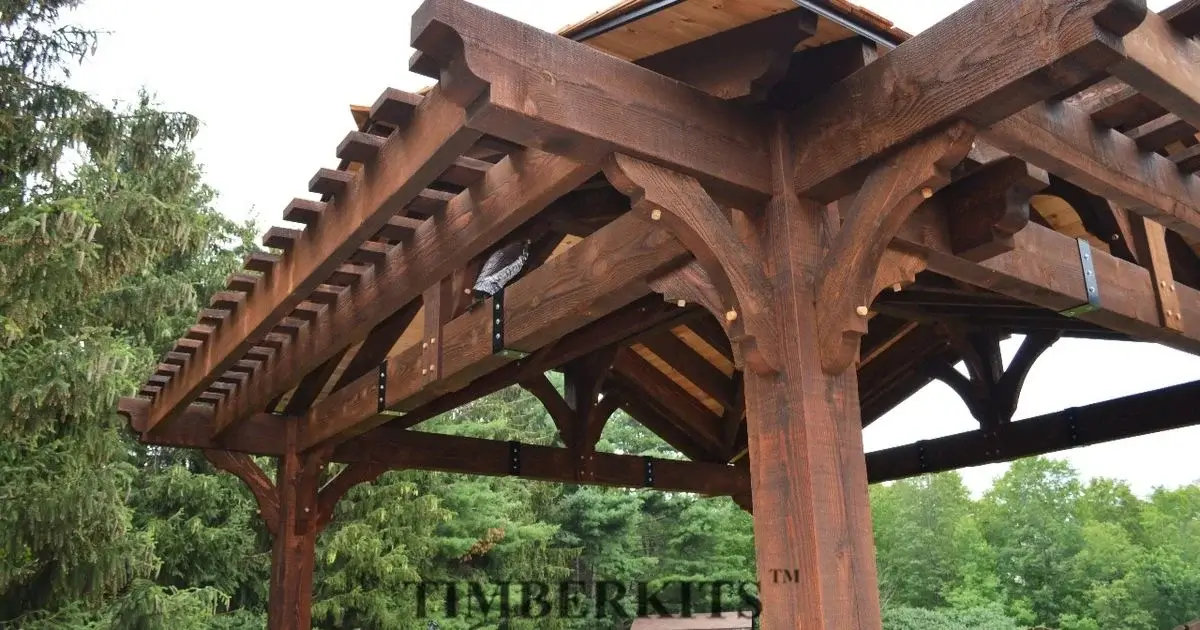
Dressed and brushed timber isn't dressed for appearance, though the smooth finish highlights the grain. The four-sided surfacing makes every piece dimensionally consistent, which is what allows mortise and tenon joinery to fit precisely without site adjustment.
Rough-cut timber can vary in thickness across the same board, sometimes measuring 7.75" on one face and 8.25" on another. That variance compounds when you're joining 8x8 posts to 6x12 Douglas Fir beams. The joints either fit or they don't, and rough-cut lumber needs shimming more often than dressed stock does.
Douglas Fir is hard and resistant to abrasion, making it suitable for uses where wear is a factor like outdoor structures that see weather exposure year-round. Dressed timber shrinks less than rough-cut as it acclimates because the surface is already uniform and the outer layers have been removed during milling.
Checks still appear — wood is wood — but they're smaller and they stop at the heartwood rather than splitting through the full thickness.
Rough-cut lumber has mill marks and surface irregularities that create pockets where stain pools unevenly. The dressed and brushed finish removes mill glaze and opens the grain slightly, which is what lets penetrating oils like CUTEK Extreme absorb uniformly across the entire surface instead of concentrating in some areas while leaving others exposed.
When dressed timber moves through seasonal moisture changes, it does so more predictably than rough stock. The uniform thickness means each face expands and contracts at roughly the same rate, which reduces twisting. Dressed timber measures what it's supposed to measure, which is why the mortise and tenon joints cut at the shop still fit tight when the structure goes up six weeks later.
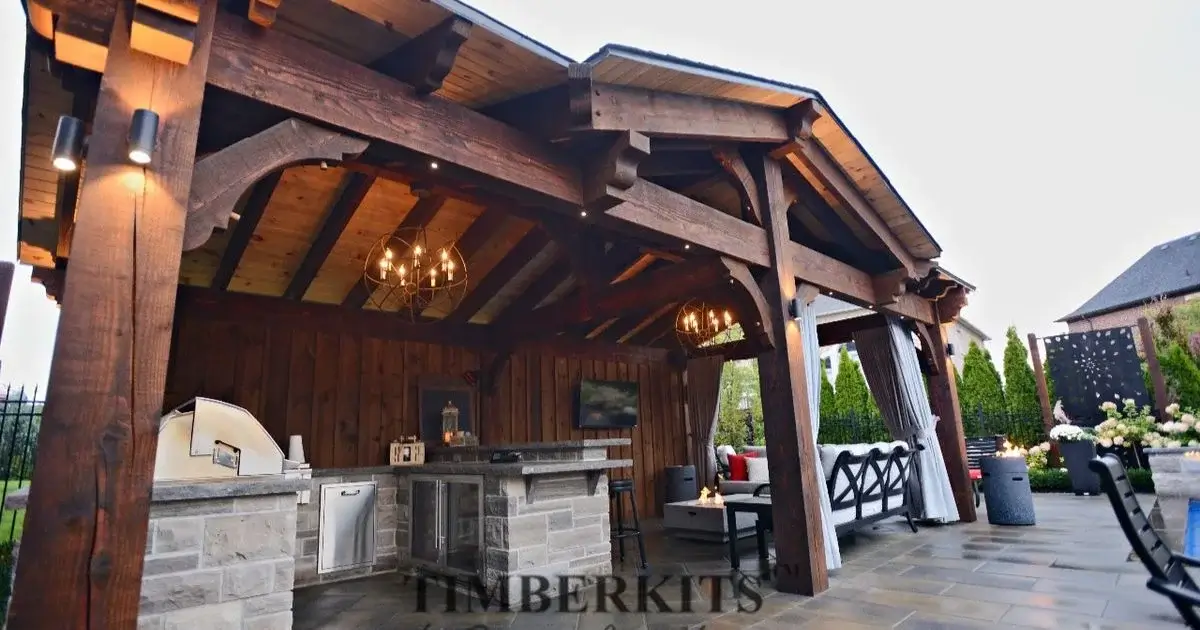
Strength-to-Weight Ratio: Why Douglas Fir Carries Load Better Than Softer Species
#1 Grade Douglas Fir is valued globally for its extraordinary strength-to-weight ratio, making it the choice for heavy structural purposes like post and beam construction. An 8x8 Douglas Fir post weighs less than denser hardwoods but carries comparable load in practice. That matters when the structure is cantilevered or when the span between posts is wide enough that beam deflection becomes a concern.
The climate across Southern Ontario and into the northern US cycles between summer heat that dries timber out and winter freeze-thaw that stresses joints. Douglas-fir has excellent strength properties and is well known for its workability. The wood dries rapidly with small dimensional movement and little tendency to check, which is what you want when the structure is outdoors year-round.
Additional structural performance data from the Canada Wood Group confirms these characteristics across commercial applications. Stiffer wood deflects less under load, which means fewer stress cracks at the joints and less movement in the structure overall.
Stiffness also matters when snow loads the roof. A pavilion built with 6x12 Douglas Fir beams spanning 16 feet will carry more snow before deflecting noticeably than the same span built with a softer species. The beam's ability to resist bending under load keeps the structure stable, and that stability means less stress transferred to the posts and less movement at the joints where the mortise and tenon connections lock the frame together.
Wood checks as it dries. Douglas Fir's density means checks stay shallow more often than they split through the full section. The heartwood is moderately decay resistant, and this softwood lumber dries well with good dimensional stability.
Dressed timber dried to the right moisture content before it ships checks less dramatically than green lumber installed wet, and when it does check, the surface cracks release internal tension rather than compromising the post's load-bearing capacity.
Sustainably Harvested: What Canadian Sourcing Actually Guarantees
Sustainably harvested timber comes from logging operations that follow standards keeping the forest functional, with a traceable supply chain back to origin. TIMBERKITS™ sources Douglas Fir from mills that meet strict Canadian grading and forestry standards. The lumber carries grade stamps identifying the mill and the grading agency that supervised the grading.
Kiln drying inhibits natural staining of the wood, improves its strength and stiffness, enhances its appearance, and increases its resistance to decay and attack by insects. The timber that arrives on site has been dried to a target moisture content, which means it's already partway through the acclimation process before the structure goes up.
Wood used outdoors will eventually stabilize at 12–18% moisture content, and kiln-dried lumber starts closer to that range than green stock does. Less movement after installation, fewer stress cracks in the first year, and joints that stay tight longer. Canadian lumber grading rules and standards are established, issued, and maintained by the National Lumber Grades Authority.
Each piece is inspected, stamped, and traceable to the mill that produced it. That chain of accountability is what separates graded lumber from commodity stock sold without verification. When a beam arrives marked #1 Grade Douglas Fir with the mill stamp and moisture content designation, you know what you're building with before the first cut.
Canadian provincial regulations require reforestation after logging, which maintains the forest's capacity to produce timber over time. TIMBERKITS™ uses sustainably harvested Douglas Fir that meets these grading standards, ensuring every pergola and pavilion uses responsibly harvested timber. The result is a supply chain that doesn't depend on old-growth logging or unregulated harvesting that degrades the forest faster than it regenerates.
Why TIMBERKITS™ Builds with #1 Grade Douglas Fir
TIMBERKITS™ uses #1 Grade Douglas Fir dressed and brushed on all four sides because it's the species that performs best under the seasonal extremes common across Ontario and into the northern US. Three-generation timber expertise means knowing what happens to structures after they're installed, not just how they look when they ship.
Mortise and tenon joinery precision CNC-cut before the kit leaves the shop only works if every piece of timber is dimensionally consistent. Rough-cut lumber or lower-grade stock with more grain deviation wouldn't fit the joinery without site adjustment, and site adjustment introduces gaps that work loose over time.
You can install the structure yourself if you want to; the kit is designed for that. TIMBERKITS™ also has its own crew who handles most installations directly, and some landscapers and contractors install these structures as part of their overall project scope. The joinery fits either way because the precision happens at the shop, not on site.
The dressed finish means CUTEK Extreme penetrates evenly across all four surfaces of every post and beam, protecting from inside the timber rather than forming a film that cracks and peels. The stain keeps moisture from cycling in and out of the wood as dramatically, which slows checking and reduces the stress on joints. Browse the TIMBERKITS™ gallery to see how this combination performs over time.
If the timber spec, the joinery precision, and the stain system matter to the project you're planning, call 905-242-0500 before the season fills up. Lead time runs 4–6 weeks, and that window can stretch longer during peak season.